
The quest to extend healthspan and lifespan has moved from science fiction to scientific reality. Regenerative medicine for longevity represents a paradigm shift in how we approach ageing, moving beyond symptom management to address the fundamental biological processes that drive age-related decline. By harnessing the body's innate healing mechanisms through advanced cellular therapies, targeted interventions, and personalised treatment protocols, regenerative approaches are redefining what it means to age healthily.
Understanding the Biology of Ageing and Regeneration
Ageing is not a single process but a complex interplay of biological changes at the cellular and molecular level. These include genomic instability, telomere shortening, epigenetic alterations, loss of proteostasis, and mitochondrial dysfunction.
One of the most significant hallmarks is cellular senescence, where cells stop dividing but remain metabolically active, secreting inflammatory factors that damage surrounding tissues. Research published in npj Aging highlights how cellular senescence biology has become a crucial target for interventions aimed at extending healthspan.

Regenerative medicine for longevity targets these fundamental processes through several mechanisms:
- Cellular replacement: Introducing new, healthy cells to replace damaged or senescent populations
- Tissue repair: Stimulating the body's natural healing processes to restore function
- Immune modulation: Rebalancing inflammatory responses that accelerate ageing
- Metabolic optimisation: Supporting cellular energy production and waste removal
The Role of Stem Cells in Healthy Ageing
Stem cells serve as the body's natural repair system, maintaining and regenerating tissues throughout life. However, stem cell function declines with age, contributing to reduced healing capacity, tissue degeneration, and increased vulnerability to disease.
Mesenchymal stem cells (MSCs) have emerged as particularly promising for longevity applications. These cells possess unique properties that make them ideal for regenerative interventions:
| Property | Benefit for Longevity |
|---|---|
| Immune modulation | Reduces chronic inflammation (inflammageing) |
| Paracrine signalling | Stimulates tissue repair without direct differentiation |
| Homing ability | Migrates to sites of injury or inflammation |
| Low immunogenicity | Minimal rejection risk, even from allogeneic sources |
Umbilical cord-derived mesenchymal stem cells represent a particularly valuable source. These young, highly potent cells demonstrate superior proliferative capacity and regenerative potential compared to stem cells harvested from older donors.
Cellular Therapies Targeting Age-Related Decline
The application of regenerative medicine for longevity extends beyond simple cell replacement. Modern approaches employ sophisticated cellular engineering and targeted delivery methods to maximise therapeutic benefit.
Senolytic and Senomorphic Strategies
Senescent cells accumulate with age and contribute to tissue dysfunction through the senescence-associated secretory phenotype (SASP). Eliminating these cells or modulating their inflammatory output has shown remarkable effects in preclinical models.
Advanced approaches now include engineered senolytic CAR-T cells that target and eliminate senescent cells, demonstrating effects on age-related metabolic dysfunction. This represents a convergence of immunotherapy and regenerative medicine.
Key senolytic strategies include:
- Small molecule senolytics that selectively induce senescent cell death
- Engineered immune cells targeting senescence markers
- Senomorphics that suppress SASP without killing cells
- Combination approaches maximising efficacy whilst minimising side effects
Exosome Therapy and Cell-Free Approaches
Not all regenerative interventions require whole cells. Exosomes, tiny vesicles secreted by stem cells, carry bioactive molecules that mediate many regenerative effects.
Exosome therapy offers several advantages for longevity applications. The cell-free nature eliminates concerns about cellular rejection or uncontrolled proliferation. Storage and standardisation are simplified. Dosing can be precisely controlled.

These microscopic messengers contain proteins, lipids, and genetic material that influence recipient cells, promoting tissue repair, reducing inflammation, and supporting cellular metabolism. Research continues to identify specific exosomal cargoes responsible for anti-ageing effects.
Personalised Longevity Programmes and Clinical Applications
Regenerative medicine for longevity is most effective when integrated into comprehensive, personalised programmes that address individual biological age and health status.
Biological Age Assessment
Chronological age (years lived) differs significantly from biological age (physiological condition). Advanced assessment tools now measure biological age through:
- Epigenetic clocks analysing DNA methylation patterns
- Telomere length measurement
- Inflammatory biomarker panels
- Metabolomic profiling
- Advanced imaging of tissue and organ health
Recent clinical research on therapeutic plasma exchange demonstrates measurable impacts on biological age, validated through multi-omics analysis. This underscores how regenerative interventions can reverse markers of biological ageing.
Integrating Stem Cell Therapy into Longevity Medicine
Pharmaceutical-grade stem cell preparations form the cornerstone of many regenerative longevity programmes. At StemCells21, personalised longevity programmes combine regenerative medicine with advanced health assessments to support healthy ageing, using pharmaceutical-grade umbilical cord-derived mesenchymal stem cells (UC-MSCs) to promote long-term wellness, resilience, and an active future.
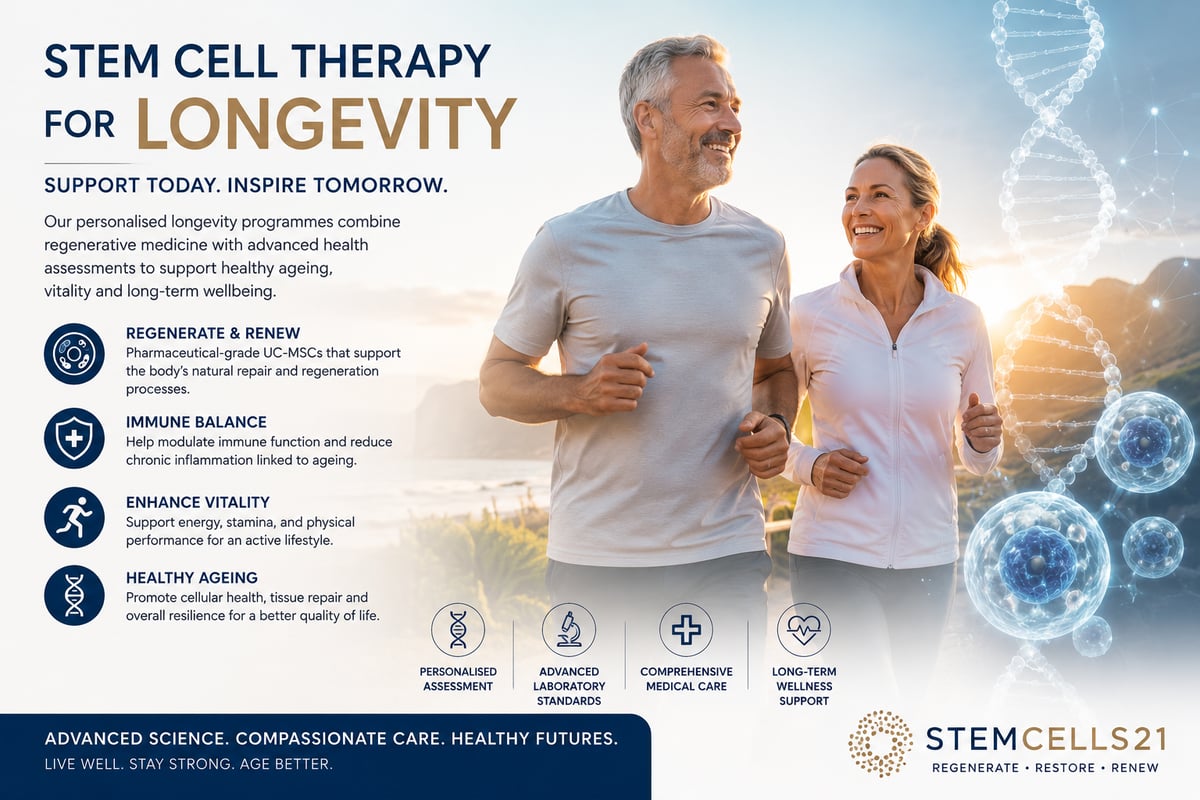
Treatment protocols typically involve:
- Comprehensive baseline assessment: Biological age testing, inflammatory markers, organ function, and metabolic health
- Personalised treatment design: Cell dose, administration route, and frequency tailored to individual needs
- Targeted delivery: Intravenous, local injection, or combination approaches
- Supportive interventions: Nutritional optimisation, lifestyle modifications, and supplementary therapies
- Longitudinal monitoring: Regular reassessment of biomarkers and biological age metrics
The regenerative effects extend across multiple organ systems. Improvements in immune function reduce susceptibility to infection and autoimmune conditions. Enhanced tissue repair supports musculoskeletal health and mobility. Metabolic optimisation improves energy levels and body composition.
Quality Standards and Safety in Regenerative Longevity Medicine
The therapeutic potential of regenerative medicine for longevity depends critically on product quality, safety testing, and clinical expertise.
Manufacturing and Quality Control
Not all stem cell products offer equivalent therapeutic value. Manufacturing standards determine cell viability, potency, and safety:
| Quality Parameter | Importance for Longevity Applications |
|---|---|
| Cell viability | Ensures therapeutic cells survive and function post-administration |
| Potency testing | Confirms cells retain regenerative and immunomodulatory capabilities |
| Sterility | Prevents infection risk, critical for immune-compromised older adults |
| Genetic stability | Ensures cells maintain normal chromosomal structure |
| Identity verification | Confirms correct cell type and source |
Pharmaceutical-grade production facilities employ rigorous quality systems, documented manufacturing processes, and comprehensive testing protocols. These standards protect patient safety whilst maximising therapeutic benefit.
Clinical Expertise and Personalisation
The same cellular product can yield vastly different outcomes depending on treatment design and clinical execution. Factors influencing efficacy include:
- Patient selection and assessment: Identifying candidates most likely to benefit
- Dosing strategies: Determining optimal cell numbers and treatment frequency
- Administration methods: Selecting delivery routes that maximise cell retention and function
- Adjunctive therapies: Combining cellular therapy with supportive interventions
- Monitoring protocols: Tracking response and adjusting treatment accordingly
Experienced medical teams in regenerative medicine understand these nuances. They design protocols based on current research evidence whilst tailoring treatment to individual patient characteristics.

Future Directions in Regenerative Longevity Medicine
The field of regenerative medicine for longevity continues evolving rapidly, with emerging technologies promising even more sophisticated interventions.
Genetic and Epigenetic Reprogramming
Cellular reprogramming technologies can potentially reset aged cells to more youthful states. Partial reprogramming strategies activate rejuvenation pathways without triggering unwanted dedifferentiation.
Epigenetic editing tools allow precise modification of gene expression patterns that change with age. These approaches might reverse specific aspects of cellular ageing whilst preserving cell identity and function.
Artificial Intelligence and Precision Medicine
Machine learning algorithms now analyse vast datasets to identify biomarkers predicting treatment response, optimise dosing protocols, and personalise intervention timing.
AI-driven approaches can:
- Predict biological age with greater accuracy than traditional methods
- Identify patients who will respond best to specific regenerative interventions
- Optimise treatment timing based on individual ageing trajectories
- Design combination therapies targeting multiple ageing mechanisms simultaneously
Combination Strategies and Systems Approaches
Single interventions, whilst beneficial, may prove insufficient to dramatically extend healthspan. The future lies in rationally designed combination approaches addressing multiple ageing hallmarks.
Promising combinations include:
- Stem cell therapy plus senolytics for cellular rejuvenation and senescent cell clearance
- Metabolic interventions combined with regenerative medicine for synergistic effects
- Immunotherapy approaches enhancing both anti-ageing and anti-cancer immunity
- Tissue-specific regenerative strategies tailored to individual organ health
Practical Considerations for Patients Considering Regenerative Longevity Therapy
Individuals exploring regenerative medicine for longevity face numerous decisions regarding treatment selection, provider choice, and expectation management.
Evaluating Treatment Centres and Protocols
Not all facilities offering regenerative therapies maintain equivalent standards. Critical evaluation criteria include:
- Regulatory compliance: Operation under appropriate healthcare regulations
- Manufacturing quality: Pharmaceutical-grade cell production with documented quality systems
- Medical expertise: Experienced physicians specialising in regenerative medicine
- Transparent protocols: Clear explanation of treatment rationale, methods, and expected outcomes
- Evidence-based approach: Protocols informed by published research and clinical experience
Setting Realistic Expectations
Regenerative medicine for longevity offers genuine potential to improve healthspan, but is not a miracle cure for ageing. Realistic expectations include:
What regenerative therapy can offer:
- Modulation of inflammatory processes driving age-related decline
- Support for tissue repair and maintenance
- Improvement in functional markers of biological age
- Enhanced quality of life and physical capability
- Potential disease risk reduction
What regenerative therapy cannot promise:
- Immortality or dramatic lifespan extension (current evidence insufficient)
- Reversal of all age-related changes
- Guaranteed specific outcomes (individual responses vary)
- Replacement for healthy lifestyle practices
Investment and Long-term Planning
Regenerative longevity programmes represent a significant investment in health. Costs vary based on protocol complexity, cell product quality, and facility standards.
Treatment typically isn't a one-time intervention but rather part of an ongoing health optimisation strategy. Maintenance protocols, periodic reassessment, and complementary interventions contribute to sustained benefit.
Financial planning should account for initial treatment costs, potential follow-up procedures, and supportive therapies. Many patients view this as preventive investment, potentially reducing future healthcare expenditure on age-related disease management.
The Science-Backed Path to Extended Healthspan
Evidence supporting regenerative medicine for longevity continues accumulating through both preclinical research and clinical studies. Whilst dramatic lifespan extension remains unproven in humans, improvements in healthspan markers are well documented.
Published studies demonstrate that stem cell therapy can reduce inflammatory biomarkers, improve physical function scores, enhance cognitive performance measures, and modulate immune system balance. These changes correlate with reduced biological age and improved quality of life.
The regenerative approach differs fundamentally from conventional medicine's focus on disease treatment after onset. Instead, it addresses the underlying biological processes driving age-related decline before significant dysfunction occurs.
This preventive, regenerative paradigm represents the future of longevity medicine. As research progresses and technologies advance, regenerative interventions will likely become standard components of comprehensive healthy ageing programmes.
Regenerative medicine for longevity offers a scientifically grounded approach to extending healthspan by addressing the fundamental biology of ageing through cellular therapies, immune modulation, and personalised treatment protocols. As this field continues evolving, individuals seeking to optimise their healthy ageing have access to increasingly sophisticated interventions backed by rigorous research. If you're interested in exploring how regenerative medicine might support your longevity goals, StemCells21 offers personalised programmes combining pharmaceutical-grade stem cell therapy with comprehensive health assessment at our state-of-the-art facility in Bangkok, helping patients achieve optimal wellness and vitality as they age.