
Osteoarthritis remains one of the most prevalent degenerative joint conditions worldwide, affecting millions of people and significantly impacting mobility, independence, and quality of life. Traditional management strategies-ranging from physiotherapy and analgesics to corticosteroid injections and eventual joint replacement-offer symptom relief but do not address the underlying cartilage degradation and inflammatory processes. As regenerative medicine advances, stem cell therapy for osteoarthritis has emerged as a promising biological approach that aims to modulate inflammation, support tissue repair, and potentially slow disease progression. With growing clinical evidence and refined protocols, patients and clinicians alike are evaluating whether this innovative treatment can deliver meaningful, durable improvements in joint function.
Understanding Osteoarthritis and Its Challenges
Osteoarthritis is characterised by the progressive breakdown of articular cartilage, the smooth tissue that cushions the ends of bones within joints. As cartilage deteriorates, bones begin to rub together, causing pain, stiffness, swelling, and reduced range of motion. The condition typically affects weight-bearing joints such as the knees, hips, and spine, though it can also impact the hands and other areas.
The Limitations of Conventional Treatment
Current clinical guidelines, including those from the National Institute for Health and Care Excellence, recommend a stepwise approach:
- Non-pharmacological interventions: exercise, weight management, and education
- Pharmacological options: paracetamol, topical and oral NSAIDs
- Intra-articular injections: corticosteroids or hyaluronic acid
- Surgical intervention: joint replacement for end-stage disease
While these strategies provide varying degrees of symptom control, none reverse cartilage loss or modify the disease trajectory. Many patients experience only temporary relief, and long-term NSAID use carries cardiovascular and gastrointestinal risks. Joint replacement, though effective, is invasive, requires significant recovery time, and is generally reserved for severe cases.

Why Regenerative Medicine Offers a New Paradigm
Regenerative approaches seek to harness the body's inherent repair mechanisms. Stem cell therapy for osteoarthritis represents a shift from symptom management to biological intervention, targeting inflammation, cartilage health, and the joint microenvironment. Mesenchymal stem cells (MSCs), in particular, have garnered attention for their ability to secrete anti-inflammatory cytokines, growth factors, and extracellular vesicles that may support tissue homeostasis.
The Science Behind Stem Cell Therapy for Osteoarthritis
Mesenchymal stem cells are multipotent stromal cells capable of differentiating into various cell types, including chondrocytes (cartilage cells), osteoblasts (bone cells), and adipocytes. More importantly, MSCs exert powerful paracrine effects-they release bioactive molecules that modulate immune responses, reduce inflammation, and stimulate endogenous repair processes.
Mechanisms of Action
| Mechanism | Description |
|---|---|
| Immunomodulation | MSCs secrete factors (e.g., PGE2, TGF-β, IDO) that shift macrophages from pro-inflammatory to anti-inflammatory phenotypes |
| Anti-inflammatory signaling | Reduction of pro-inflammatory cytokines (IL-1β, TNF-α) and increase in anti-inflammatory mediators (IL-10) |
| Trophic support | Release of growth factors (VEGF, bFGF, HGF) that support cell survival, angiogenesis, and tissue remodeling |
| Chondroprotection | Potential to slow cartilage degradation and support matrix synthesis, though extent varies by study |
A review in Cellular & Molecular Immunology highlights that while MSCs show promise in preclinical models, translation to consistent clinical benefit requires optimised cell sourcing, dosing, and delivery protocols.
Sources of Mesenchymal Stem Cells
MSCs can be derived from multiple tissues, each with distinct characteristics:
- Bone marrow-derived MSCs (BM-MSCs): well-studied but decline in potency with donor age
- Adipose-derived MSCs (AD-MSCs): abundant and easily harvested via liposuction
- Umbilical cord-derived MSCs (UC-MSCs): young, highly proliferative cells obtained from donated tissue following healthy births
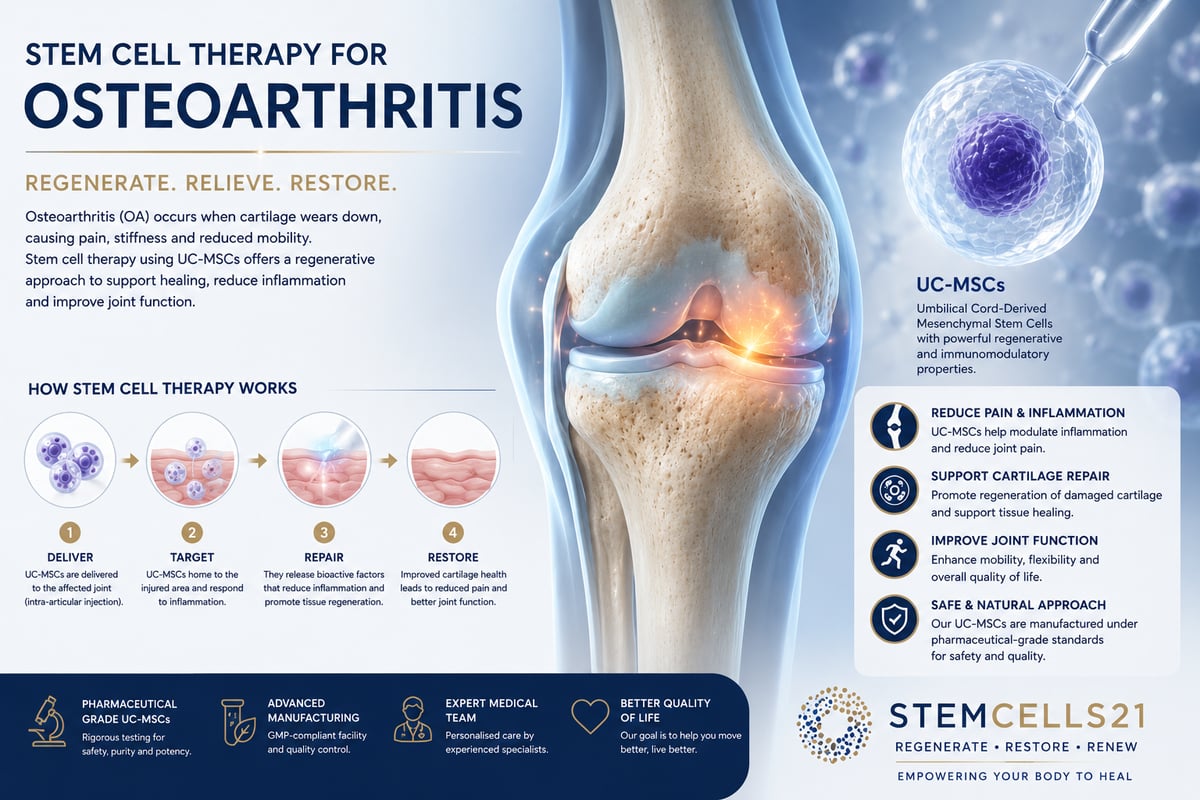
UC-MSCs are increasingly favoured for their robust expansion capacity, low immunogenicity, and consistent quality when manufactured under pharmaceutical-grade standards. They avoid the invasive harvesting procedures required for autologous (patient-derived) cells and offer a standardised, off-the-shelf product.
Clinical Evidence: What the Trials Show
The evidence base for stem cell therapy for osteoarthritis has expanded significantly in recent years, with numerous randomised controlled trials (RCTs), systematic reviews, and meta-analyses now available.
Randomised Controlled Trials
A notable phase III double-blind trial evaluated autologous adipose-derived MSCs for knee osteoarthritis. Patients receiving MSC injections demonstrated statistically significant improvements in pain scores and functional outcomes compared to placebo at 12-month follow-up, with a favourable safety profile. Adverse events were predominantly mild and transient, such as injection-site swelling or stiffness.

Another key study design involved multiple intra-articular injections over several months, reflecting real-world protocols used in specialised regenerative medicine clinics. Outcomes consistently showed reductions in visual analogue scale (VAS) pain scores and Western Ontario and McMaster Universities Osteoarthritis Index (WOMAC) scores, though the magnitude of benefit varied.
Systematic Reviews and Meta-Analyses
A 2024 systematic review and meta-analysis pooled data from multiple RCTs, revealing:
- Pooled pain reduction: moderate to large effect sizes favouring MSC therapy
- Functional improvement: statistically significant gains in mobility and daily activities
- Safety: low incidence of serious adverse events; most were self-limiting
- Heterogeneity: variation in cell type, dose, delivery method, and patient selection
The authors noted that while results are encouraging, heterogeneity in trial design limits the ability to draw definitive conclusions. Standardisation of protocols and longer follow-up periods are needed to establish durability of response.
The Cochrane living systematic review provides an ongoing synthesis of high-quality evidence, assessing certainty using GRADE methodology. As of 2026, it concludes that MSC injections may improve pain and function in the short to medium term, but evidence quality remains moderate due to inconsistency and risk of bias in some studies.
Treatment Protocols and Delivery Methods
Effective stem cell therapy for osteoarthritis depends on several key variables: cell source, dose, route of administration, and adjunctive therapies.
Dosing and Administration
Typical intra-articular doses range from 10 million to 100 million cells per injection, though optimal dosing remains under investigation. Some protocols involve a single injection, while others employ a series of two or three injections spaced weeks apart to sustain therapeutic effects.
Delivery routes include:
- Intra-articular injection: direct delivery into the joint space, maximising local concentration
- Intravenous infusion: systemic delivery for widespread anti-inflammatory effects, though less targeted to the joint
- Scaffold-assisted implantation: cells embedded in biomaterials to enhance retention and integration
Most clinical studies and real-world protocols favour intra-articular injection for knee osteoarthritis due to targeted delivery and lower systemic exposure.
Adjunctive Therapies
Combining MSC therapy with other interventions may optimise outcomes:
- Platelet-rich plasma (PRP): synergistic growth factor release
- Hyaluronic acid: improved cell retention and joint lubrication
- Physiotherapy: strengthening surrounding musculature to support joint stability
Patients are typically advised to avoid NSAIDs immediately before and after treatment, as these may interfere with the inflammatory signaling that guides MSC homing and engraftment.
Emerging Approaches: Exosomes and Cell-Free Therapies
Beyond whole-cell injections, researchers are exploring MSC-derived exosomes-tiny vesicles secreted by stem cells that carry therapeutic proteins, lipids, and RNA. A Frontiers review discusses exosomes as a cell-free alternative that may offer several advantages:
- Reduced regulatory complexity: simpler manufacturing and storage
- Lower immunogenicity: fewer concerns about cell rejection or adverse immune reactions
- Enhanced reproducibility: batch-to-batch consistency easier to achieve
Early-phase clinical trials are investigating exosome injections for knee osteoarthritis, with preliminary data suggesting similar anti-inflammatory and analgesic effects to whole-cell therapy. While promising, exosome therapy remains largely experimental in 2026, with most patients still receiving traditional MSC injections.
Patient Selection and Expectations
Not all patients with osteoarthritis are ideal candidates for stem cell therapy. Clinicians consider several factors when evaluating suitability:
Ideal Candidates
- Mild to moderate disease: patients with Kellgren-Lawrence grade 2 or 3 osteoarthritis tend to respond best
- Active inflammation: those with evidence of synovitis or effusion may benefit from MSC immunomodulation
- Failed conservative management: individuals who have exhausted physiotherapy, weight loss, and standard injections
- Desire to delay surgery: patients seeking to postpone or avoid joint replacement
Poor Candidates
- Severe bone-on-bone arthritis: limited cartilage substrate for repair; joint replacement may be more appropriate
- Unrealistic expectations: those expecting complete cartilage regeneration or guaranteed cure
- Active infection or systemic illness: contraindications to any intra-articular procedure
Comprehensive pre-treatment assessment, including imaging (X-ray, MRI) and clinical evaluation, ensures appropriate patient selection.
Safety Profile and Adverse Events
One of the most reassuring aspects of stem cell therapy for osteoarthritis is its safety record. Across multiple trials and real-world case series, serious adverse events are rare.
Common Mild Reactions
| Adverse Event | Frequency | Management |
|---|---|---|
| Injection-site pain | 10-20% of patients | Self-limiting; resolves within 2-3 days |
| Joint swelling | 5-15% | Ice, rest, occasionally short-course NSAIDs |
| Stiffness | 5-10% | Gentle mobilisation and physiotherapy |
Serious Adverse Events
Infection, thrombosis, and immune reactions are exceptionally rare when proper sterile technique and pharmaceutical-grade cells are used. Long-term oncological concerns (tumour formation) have not been observed in clinical follow-up studies extending several years, though ongoing surveillance remains important.
Real-World Application: What to Expect During Treatment
Patients considering stem cell therapy for osteoarthritis often want to know what the treatment journey entails. At specialised regenerative medicine centres, the process typically unfolds as follows:
- Initial consultation: comprehensive medical history, examination, and imaging review
- Treatment planning: discussion of cell source (autologous vs. allogeneic), dosing, and number of injections
- Pre-treatment preparation: avoiding anti-inflammatory medications, ensuring joint is free of active infection
- Injection procedure: performed under sterile conditions, often with ultrasound or fluoroscopic guidance to ensure accurate intra-articular placement
- Post-treatment protocol: rest for 24-48 hours, gradual return to activity, physiotherapy to optimise joint mechanics
- Follow-up assessments: serial evaluations at 1, 3, 6, and 12 months to monitor pain, function, and adverse events
At StemCells21, patients receive personalised treatment programmes using pharmaceutical-grade umbilical cord-derived mesenchymal stem cells. These cells are rigorously tested for safety and quality, and our Osteoarthritis Stem Cell Treatment protocols are designed to support joint health, improve mobility, and help patients maintain an active lifestyle under expert medical care.
Cost, Accessibility, and Insurance Considerations
Stem cell therapy for osteoarthritis is not universally covered by public health systems or private insurance in 2026. In many countries, it remains classified as an investigational or experimental treatment, meaning patients often bear the full cost.
Typical costs range from £3,000 to £8,000 per treatment session, depending on cell source, clinic location, and ancillary services (imaging, physiotherapy). Autologous cell harvesting and processing may incur additional fees.
International medical travel is common, with patients seeking treatment at centres in Thailand, Mexico, and Eastern Europe, where costs may be lower and regulatory pathways more established. It is essential to verify clinic accreditation, cell manufacturing standards, and clinician expertise before committing to treatment abroad.
Some insurers are beginning to offer coverage for MSC therapy within clinical trial settings or as part of research programmes, but routine reimbursement remains limited.
Regulatory Landscape and Quality Standards
The regulatory status of stem cell therapy for osteoarthritis varies globally. In the European Union, MSCs are classified as Advanced Therapy Medicinal Products (ATMPs), requiring rigorous preclinical and clinical data for marketing authorisation. The UK follows similar frameworks post-Brexit.
In the United States, the Food and Drug Administration (FDA) regulates stem cell products, and most MSC therapies for osteoarthritis are delivered under Investigational New Drug (IND) applications or as part of registered clinical trials.
Quality standards to look for when evaluating a clinic include:
- Pharmaceutical-grade manufacturing: GMP-certified facilities with rigorous quality control
- Third-party testing: independent verification of cell identity, viability, sterility, and potency
- Transparent sourcing: ethical procurement of donor tissue with informed consent
- Clinical governance: board-certified physicians with regenerative medicine expertise
Patients should be wary of clinics offering unproven "stem cell" therapies without proper regulatory oversight or verifiable cell characterisation.
Future Directions and Ongoing Research
The field of regenerative medicine is evolving rapidly. Current research priorities include:
- Optimising cell dosing and timing: determining the ideal number of cells and injection frequency for maximal benefit
- Combination therapies: integrating MSCs with gene therapy, biomaterials, or pharmacological agents
- Biomarker discovery: identifying which patients are most likely to respond based on genetic, proteomic, or imaging markers
- Long-term durability: extending follow-up beyond 12-24 months to assess sustained benefit and need for re-treatment
- Comparative effectiveness: head-to-head trials comparing MSCs to PRP, hyaluronic acid, and surgical options
National and international consortia, such as those coordinating updates to NICE guidance, continue to monitor emerging evidence and update clinical recommendations accordingly.

Weighing the Evidence: Is Stem Cell Therapy Right for You?
Deciding whether to pursue stem cell therapy for osteoarthritis requires careful consideration of the current evidence, individual disease severity, treatment goals, and financial resources. The therapy is not a miracle cure, but it offers a biologically plausible mechanism and growing clinical support for patients who have not responded adequately to conventional treatments.
Key questions to discuss with your clinician:
- What is the severity of my osteoarthritis, and am I a suitable candidate?
- What cell source and protocol does the clinic use, and what is the supporting evidence?
- What are realistic expectations for pain reduction and functional improvement?
- What is the safety profile, and how will adverse events be monitored?
- What is the total cost, and are there financing or insurance options?
Transparency, shared decision-making, and realistic goal-setting are essential components of the patient journey. For the latest updates on clinical trials and emerging therapies, patients can explore resources on stem cell research and news to stay informed.
Practical Considerations for Patients
Beyond the clinical and scientific aspects, practical logistics play a significant role in treatment success.
Preparing for Treatment
- Medical clearance: ensure no active infections, uncontrolled diabetes, or contraindications
- Medication review: discuss with your doctor whether to pause anticoagulants or immunosuppressants
- Activity modification: plan for 1-2 weeks of reduced activity post-injection to allow cell engraftment
Post-Treatment Rehabilitation
Physiotherapy is a cornerstone of recovery. A structured programme should include:
- Range-of-motion exercises: gentle mobilisation to prevent stiffness
- Strengthening: progressive resistance training for quadriceps, hamstrings, and hip stabilisers
- Proprioceptive training: balance and coordination exercises to protect the joint
Regular follow-up with both the regenerative medicine team and a musculoskeletal physiotherapist optimises outcomes.
Stem cell therapy for osteoarthritis represents an exciting frontier in regenerative medicine, offering a biologically targeted approach to a condition that affects millions worldwide. While the evidence base continues to mature, current data support its safety and potential efficacy in carefully selected patients. For those seeking personalised, advanced treatment options, StemCells21 provides pharmaceutical-grade umbilical cord-derived mesenchymal stem cells and expert medical care at our state-of-the-art facility in Bangkok, helping patients improve joint health, mobility, and quality of life. Explore how our regenerative medicine programmes can support your journey towards better musculoskeletal health today.